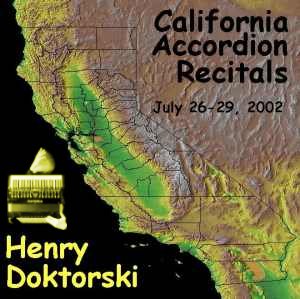
 Henry Doktorski:
Victoria 140-bass convertor/free-bass piano
accordion
Henry Doktorski:
Victoria 140-bass convertor/free-bass piano
accordion
Henry Doktorski:
Victoria 140-bass convertor/free-bass piano
accordion
Program:
George Friederich Handel, Suite for a Musical
Clock:
George Gershwin, Three Preludes:
Guido Deiro, Ten Vaudeville Classics:
Order from:
Henrydoktorski.com.
To listen to soundfiles from this CD, go to
henrydoktorski.com/soundfiles.html.
Review by Dr. Paul Allan Magistretti
When Henry Doktorski agreed to perform four recitals in California this year, he decided to combine some of the content of two forthcoming CDs, Classical Accordion Classics and Vaudeville Classics. The titles are self-explanatory and the list of selections indicate the nature of the music. Also included on the CD was a world premiere of a piece written especially for Henry by the composer Alan Hovhaness, Hymn. In concert Henry included some pieces not on the CD and eliminated others from his program; for example, his excellent performance of Johann Ludwig Krebs' Prelude wasn't included, nor was his version of Monti's Czardas, but the CD includes three preludes by Gershwin and Deiro's Egypto Fantasy, which he didn't play in concert.
Henry has a genuine feeling for baroque music and his performance of the Handel Suite for a Musical Clock is excellent; he plays it with a clean, clear and singing quality. The Air is particularly beautiful. The Suite may represent his best work on this CD and is comparable to the work of an outstanding specialist in baroque like Øivind Farmen.
I was glad to see someone include Schumann's Träumerei on an accordion album. Henry plays it well and with feeling. However, I would like a stronger, dream-like quality and a greater sense of space—the piece should float. Perhaps what might create a more lilting quality would be a better use of musical silence. For example, if in the opening at the 9 second mark the note decayed more it would not only define the phrase better, but it would set up the mood for the rest of the piece; instead, there's a sense of "moving right along." The problem with the accordion is that since it can make continuous sounds, performers are seduced into playing it that way. Why not let notes play and exhale into silence at the end of certain phrases? It's a primary element in articulation and realized by most accomplished performer's of every other instrument. Piazzolla mastered it, even to the extent of using his air release as a musical element. However, Henry does exactly the right thing very nicely at 1:23. And his expression is lovely at the end, but on the penultimate, long sustained note there was a perfect opportunity to let it fade into silence—and he didn't.
He does a good job with Brahm's overly familiar Hungarian Dance No. 5. I did think he played it a little fast at times and seemed to overrun his technique in certain passages; there were triplets throughout that were shorted and ended up seeming not as clean as they could be. He does quite well on the contrasting slow passages and a little better on his return to the fast passages; sometimes, however, I thought the tempo might be getting away from him.
Henry definitely evidences a talent for modern works —and not to make unfair comparisons—it is interesting that Glenn Gould similarly had an affinity for baroque and modernity (at least, Schoenberg, Bartok, Krenek, Hindemith, Prokofiev, etc.). Gershwin's Three Preludes can't really be considered that modern in the sense of today's new music, or even the five previous listed composers, but they're good works; interesting miniatures that contain insightful excursions into Gershwin's less popular thinking. You might say they're images of Gershwin's take on synthesizing jazz and keyboard composition in a classical vein, similar to his take on jazz and composing for an orchestra and piano in Rhapsody in Blue. Henry's performance of the preludes is generally quite good. My only qualification would be: I might like a stronger sense of swing. Jazz is all about propulsive accents and syncopating energy and despite Henry's rhythmic correctness on the pieces I somehow wanted a little more Jazz Age edginess. Individually: his playing is good throughout Allegro ben ritmato e deciso (9)—I thought the pause and switch click at the end was unfortunate; Andante con moto e poco rubato (10) is bluesy, but I felt it could be a bit bluer, a mite dirtier; the final prelude has an aura of a "Jazz Age Big City" cityscape and Henry catches the pace and contrast nicely. I'm glad he performed these Gershwin miniatures and he interprets them nicely without the advantage of dozens of other accordion performances to inform; pianists can hear Chopin played by thousands of others and seek a well- worn rut or do a 180 on the rut and deliver "their own" interpretation. Henry's interpretive choices on the Gershwin preludes are his own and they're tasty and insightful. If I've carped about a need for more propulsive accents and energy it may be that the pieces were written for the piano, which is a percussion instrument, and at times I may have inferred the dynamics I missed.
Henry's performance of Alan Hovhaness' brief Suite for Accordion is very good, his execution clean. The Solene movement is like a chant, almost Gregorian at times, with bass and treble playing in contrasting keys. The Presto is quasi baroque and Henry is in his element—excellent, but over too soon. The Allegro Vivo seems to intentionally evoke a bagpipe with a hint of Middle Eastern quartertones. The composer's Hymn, which was written for Henry, interestingly toys with the Dies Irae theme. It's not a major work, but as a concept for the accordion it's effective and played quite well. Henry's breath control is good; neither Hovhaness nor any listener could ask for more.
Henry plays Piazzolla's Oblivion with a fine sense of lyricism. His opening run at 44 seconds is lovely (& even better at 3:49 ff.) and equally nice each time on its repeat. It's amazing how a few notes can jump out at a listener. I played the CD for others and they all perked up on the run and said, "That's lovely; he did something there." What is it when something like that happens? Was there a connection between the player and something beyond—within? An insight, an intuition —maybe something unconscious and Henry doesn't even know what we're talking about —but it can happen in even a few notes and it did here. The contrasting B section is energetic and well played. Henry feels the piece deeply and conveys his complex feelings of despair, hope and reconciliation—a neurasthenic triptych that Piazzolla felt deeply. I would like a bit more shaping of the long, sustained notes; not to imitate Piazzolla, but to give them their full vocal value—they're not notes, they're laments, incantations. And perhaps if the anguish of the A section deepened, it would pull the whole piece together a bit more as a "story" of a heartfelt path towards the moment when that nicely dissonant, arpeggiated chord at the end proclaims its bittersweet irony. But all in all, Henry does a fine job.
I like Henry's own composition, Rondo Polska; it's a literal scherzo, or joke. Henry is having fun with a simple three-note theme and the many ways he can topsy-turvy it. It's rare that we have humor expressed in accordion music; this is a light, pleasant example. I haven't seen the score, but I feel he might clean up the runs; for example, around 56 seconds and forward on the repeats of same; I shouldn't argue with the composer, but Henry has played so well elsewhere that he's created expectations of qualitative equanimity.
Guido Deiro's compositions are perfect examples of music from the Golden Age of Vaudeville, as well as being worthy in their own right—however, keep in mind that they're purposely showy, extroverted romps directed at a listener's senses in a generally cheerful, jazzy, assaultive manner. Above all, Vaudeville was a show; it was a medium in which a player had to capture and hold a large, not always attentive audience's interest. The longer and more intensely a person could enthrall his listeners and transform them into a single, pulsating organism, was what determined who became a headliner—the one who drew the crowds. Guido Deiro, among all the pianists, trumpeters, clowns, dancers, jugglers, comics, singers and animal acts, shone as one of the brightest stars on the circuit—and he was a man alone on stage with a simple, acoustic accordion —nothing more; and it put him on the theater marquis, at the top of the bill, the unquestioned headliner, a star; he could go by one name: Deiro!
Henry is rendering a valuable service by presenting some of Deiro's pieces on this CD. Generally, I think he does a fine job; however, I think as he gets deeper into the material, he will need to make them jazzier (rags and jazz were considered erotic, after all)—this may be a matter of syncopated energy and accents; unless it's just my erroneous and idiosyncratic taste. But Deiro's music comes from the early days of rags and jazz—it was hot stuff for its time; this concept may be hard for us to get in the twenty-first century, but it's there to be gotten. Also, the pieces have certain performance dimensions that need to be filled.
The Deiro Rag was very well played by Henry, but I wanted it bigger, more subversive and dirtier. The more formal pieces have a sense of operatic pretensions (Musketeer March)—but they have to have size, too. They can't be just a pleasant tune the likes of which we'd hear at an accordion club. Marches were a rage through the early 20th century. Think of John Phillip Sousa and how even today when the Boston Pops plays The Stars and Stripes Forever, the audience gets excited and claps along. Marches were like rock and roll in those days. And Deiro's marches would certainly turn an audience on and send them humming out the door towards the nearest speakeasy.
I thought Henry caught the vaudeville flavor with Deirino Mazurka. It teases the audience with syncopation and tossed off triplets and trills. And like most of these pieces it's brash, extroverted and meant to be dazzling. Vaudeville music has both a musical shape and an equally important performance shape—a show-off structure; the performer has to take over the music the way Sinatra took over a song.
With Henry's rendition of I Don't Care Polka I could almost see Deiro striding around the stage. Henry gave me a sense of the times here—energy, excitement; adrenalin had to kick in or the accordion player would be booed off the stage: addio being a headliner, double addio making $6oo a week. I think the performer had to go on stage with a sense of, "It's the top of the ninth, two out, tie game; World Series on the line—I've got to swing for the fences." Vaudeville was big time, big money and big competition. Dozens of acts were waiting in the wings to roll over the headliner and piss on his grave if he didn't bring down the house. So, the compositions, I think, need to come alive with an undercurrent of life & death, a sense of being a high wire act; there's danger in their performance—and that's a lot of what made them work.
Lido Tango is catchy and I'm sure it was a popular tune. I thought Henry did well with it —although I wasn't totally convinced about where he placed his accents. Still, he got me humming and I think the audience would've carried it with them out the door. In this case, I could imagine Deiro using a pair of dancers interpreting the tango onstage.
The Queen of the Air March must have been written for some person (queen) and/or an event (e.g., Amelia Earhart's 1928 & 1932 flights across the Atlantic). It has the feeling of a timely celebration—maybe some research would turn up the answer. Henry starts off with exactly the right size and energy, but drops back a notch. Generally, he has a good sense of urgency and drive here.
Valse Caprice No. 1 is nicely done. It would offer the audience a lyrical break in the show. It's melodic and infectious. I thought it needed a little more legato to break a heart or two.
Henry is terrific on Neapolitans Polka —he's driving the piece; the runs are lightning fast and clean (except around 1:50-2:00). I thought he captured the real spirit of the times.
My Florence Waltz opens big and teasingly, then serves up a moody introduction of the theme—which is good and well played. Somehow I thought the performance contour of the piece needed to be clearer for the listener. Where are we being taken emotionally and why? How is the journey structured? The piece ought to evoke an immigrant's (and Deiro's) nostalgia for youth and the old country—Firenze, Italia; temps perdu: la mamma never to be seen again, all that—unless Florence was one of Guido's babes; in which case, never mind. I think Henry did some shaping on Florence, but each section needed a clear imprint of sentiment.
The final piece and obvious "big number" is Egypto Fantasia and it's Henry's strongest rendition of a Deiro composition. Of all the pieces it's the most classical—and it certainly would be connected in the popular imagination of the times with the exciting, exotic discoveries happening in Egypt. Remember, throughout the nineteenth century right up to 1922 when Howard Carter and the Earl of Carnarvon discovered King Tutankhamen's tomb—even continuing today—tombs were unearthed and scholars were publishing the results of translations from hieroglyphic texts. The Rosetta Stone had been discovered in 1799 (it was a tablet with Greek, Demotic and hieroglyphic inscriptions elucidating the same text). Scholars had been bringing out studies throughout the nineteenth, early twentieth century and Egyptian motifs were found everywhere including the décor of many of the theaters in which vaudeville shows took place. Deiro beautifully played upon the popular imagination for things exotic with his Fantasia—the piece is potent enough that when the ending theme enters I've no doubt a modern audience would instantly think of Lawrence of Arabia. The Fantasia is a virtuoso number that sets a scene and Henry paints it very well. I do think, however, that the final restatement and climax at 5:50 needs to be bigger, as if in anticipation of the resounding applause that was to come.
Henry has given us an eclectic CD and the overall achievement is quite high. It's a generous offering at 74:10 minutes and he interestingly sustains much of it. Many anthologies are more like auditions for the artist than albums, but I think Henry put the music first; he presented things he liked and wanted to bring to our intention, worthy pieces that ought to be heard and he did so in a forthright manner. In a lot of ways, the disparity of the selections gives the CD a lively, spontaneous feeling and delivers a solid sense of fun.
| About The Free-Reed Review |
| Invitation to Contributors / Submission Guidelines |
| Back to The Free-Reed Review Contents
Page |
| Back
to The Classical Free-Reed, Inc. Home
Page |