The Free-Reed Review
Critiques of Compact Discs, Books and Music Scores
CD Review: Robert Davine (with the Lamont Chamber Players)
Concert Accordion Artistry
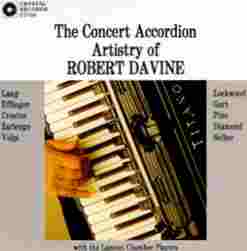
Total Time: 61:28
Released in 1995
Label: Crystal Records (CD160)
28818 NE Hancock Road
Camas, WA 98697
USA
|
Performers:
- James Maurer & Jacqueline Maurer, violins
- Charlyn Campbell, viola
- Richard Slavich, cello
- James Carroll, double bass
- Ted Zarlengo, piano
Program:
- Hans Lang: Prelude and Fugue in C
- Cecil Effinger: Nocturne
- Paul Creston: Prelude and Dance, opus 69
- Ted Zarlengo: Suite for Accordion, Cello & Piano
- Prelude
- Scherzo
- Pastoral
- Interlude
- Gigue
- Adamo Volpi: Preludio, Opus 31
- Normand Lockwood: Sonata-Fantasy
- Contemplative
- Allegro giocoso
- Adagio serioso
- John Gart: Vivo
- Carmelo Pino: Concertino
- David Diamond: Night Music
- Matyas Seiber: Introduction and Allegro
|
Review by
Henry Doktorski:
A CD like this comes along once a decade; an anthology featuring original
solo and chamber works for stradella accordion. To the author's knowledge,
the last time an album like this appeared was in 1984 with the release of
"William Schimmel - Accordion Revisited" on Finnadar Records. Davine's CD
is a re-issue of a 1979 Crystal LP with the addition of two new pieces to
take advantage of the increased length of compact discs.
The concert accordion artistry of Robert Davine should dispel in anyone's
mind the illusion that only the free-bass accordion has a future in
contemporary music. The pieces on the album are all gems for the stradella
accordion; ranging in mood from the dark despondency of David Diamond's
"Night Music" to the exuberant hilarity of Matyas Seiber's "Introduction
and Allegro."
Robert Davine is professor of accordion and theory for the Lamont School
of Music at the University of Denver. He has performed as soloist with the
Pittsburgh Symphony Orchestra, the Denver Symphony, The Denver Chamber
Orchestra, the Mantovani Orchestra, the Flagstaff (Arizona) Festival
Orchestra, the Lake Superior (Michigan) Chamber Orchestra, the Norwegian
Broadcasting Company and the Aspen Music Festival Chamber Ensemble.
Davine is a master of the classical accordion; his performances are
superb: sensitive and graceful at times, brash and powerful at other
times, as demanded by the composers. His recordings with the Lamont
Chamber Players are especially significant contributions to the
discography of the accordion. Ted Zarlengo's "Suite for Accordion, Cello &
Piano" in five movements is accessible (modal harmonies) and very pleasant
to listen to.
On the other hand, Carmelo Pino's three-movement "Concertino" for
accordion & strings (here performed by the Lamont String Quintet) is a
serious work and demands more-than-casual attention from the listener. The
thematic material from the first few measures is developed throughout the
piece; sometimes jagged and contrapuntal, sometimes lyrical and nostalgic.
Concertino was performed by the composer (also a fine accordionist) during
four concerts in March 1996 with the Washington Chamber Symphony at the
Kennedy Center.
Seiber's "Introduction and Allegro" for accordion and cello is a
glittering showpiece which functions as a brilliant encore for the album.
I have only one or two criticisms: sometimes in the "p" sections
in "Night Music" the accordion overpowers the strings; in the score both
parts are marked "p." It sounded to me like the accordion was miked
separately and then mixed with the quartet; the author would have
preferred a more natural sound. However, the balance in the rest of the
album is excellent.
In addition, the fast passages are not always as clear as they should be;
the playing is sometimes rushed, or sloppy. Another question: why doesn't
the performer play triplets in Creston's score as the composer wrote?
Despite these minor complaints, I recommend this album for all lovers of
classical accordion music.