The Free-Reed Review
Critiques of Compact Discs, Books and Music Scores
CD Review: Dancas Ocultas
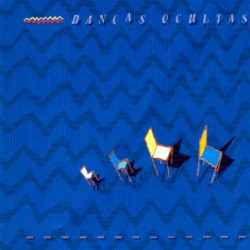
Total Time: 39:00
Released: 1996
Review Date: July 2001
Order from:
|
Performers
- Diatonic Accordions:
- Artur Fernandes
Filipe Cal
Filipe Ricardo
Francisco Miguel
Program:
- Folia
- Quartetra
- Danca I
- Danca II
- Outubro
- Noc(c)turno das 7
- Concerteza
- Momento
- Modaassim ao lado
- Queda d'agua
- Meia Folia
|
Review by Steve Mobia
The diatonic accordion is directly linked to folk
music. Its portability and reasonable cost made it a
favorite of immigrants settling around the world. By
having a different note on the push than on the pull,
more notes could be compressed into a smaller
fingerboard space. Even today, given a choice of
accordions, many folk musicians still prefer the
diatonic for performances and make claim for its
unique articulation caused by the constant pushing
and pulling to get certain tones.
It isn't often
that a musician with classical training would prefer
a diatonic accordion as it has obvious limitations in
range, phrasing and lack of chromatic scales. But
Artur Fernandes is such a person and his group
"Dancas Ocultas" from
Portugal have released a CD of the same name.
It's a pleasant melodic album that features 4
diatonic accordions without accompaniment. The tunes
are simple, resonant and go back and forth between
classical sounding and folk sounding pieces. A few
are traditional, most newly composed.
Though
Fernandes' early work with the diatonic accordion was
in the folk tradition, his interest in classical
music led him to teach his students Verdi and Bach.
Later with 3 of his best students he formed "Dancas
Ocultas." In addition to teaching and performing with
the group, Fernandes composes music for theater,
dance and film.
One unusual effect that caught my
attention was the rhythmic use of the air button by
one or more of the players creating an additional
propulsion to the music. The first and last tracks
consist entirely of these syncopated breathing
rhythms. There are also richer chords than can be
accomplished on a single diatonic accordion.
The
playing style is deliberately unornamented and
lyrical. This will surely endear some listeners to
the music. Others may get impatient with the stripped
down melodies and repeating squared off sections.
Erik Satie was an obvious inspiration for one piece,
Noc(c)turno das 7 and Satie's belief in
simplicity seems to guide the group on all the
tracks. Perhaps this is a reaction to the virtuoso
button box style of some folk performers.
According to Fernandes, since the 1990s there has
been a great resurgence among the young in
traditional Portuguese music and instruments which
were considered old fashioned. Even Pop and Rock
performers have gravitated to hurdy-gurdies, bagpipes
and the diatonic accordion. Though I was hoping to
hear the diatonic accordion used in a serious modern
context, this album really doesn't break the
instrument free of its folk music ties. Traditional
harmonies, tonalities, and meters dominate. But it
does have several inspired melodies and makes for a
pleasurable if unchallenging listening experience.
The recording quality is good though the volume is
uneven. The breathing pieces are too loud and certain
numbers would have been more effective played softer.
There is no English (or other language) translation
of the Portuguese program notes and track titles.