The Free-Reed Review
Critiques of Compact Discs, Books and Music Scores
CD Review: Mayumi Miyata
John Cage: Two4
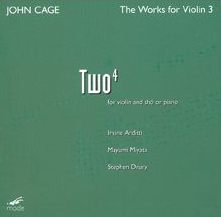
Total Time: 60:34
Released: 2000
Review Date: April 2001
Order from:
Mode (CD 88)
PO Box 1262
New York, NY 10009
USA
Phone/Fax: 212-979-1027
|
- Performers:
- Mayumi Miyata, sho
- Irvine Arditti, violin
- Stephen Drury, piano
Program:
- John Cage: Two4 for violin and sho
- John Cage: Two4 for violin and piano
|
Review by Henry Doktorski:
John Cage (1912-1992) is, without a doubt, the most influential American
composer to write a major work for a free-reed instrument. During the
course of his long life he pioneered novel new approaches to music
composition.
In 1938 he founded a percussion orchestra; his music at this time was
concerned with filling units of time with ostinatos, such as First
Construction (in Metal), (1939). He also began to use electronic
devices such as variable-speed turntables in lmaginary Landscape No.
1, (1939) and invented the 'prepared piano', placing diverse objects
between the strings of a grand piano in order to create an effective
percussion orchestra under the control of two hands.
In the 1940s,
Cage became interested in Eastern philosophies, especially in Zen, from
which he gained a treasuring of non-intention. Working to remove creative
choice from composition, he used coin tosses to determine events, such as
Music of Changes for piano (1951). He wrote for 12 radios in
Imaginary Landscape No. 4 (1951) and introduced other indeterminate
techniques. His signature piece, 4'33" (1952) has no sound added
to that of the environment in which it is performed.
Logically, Cage became interested in electronic music. Imaginary
Landscape No. 5 (1952) consists of randomly mixed recordings,
Cartridge Music (1960) consists of small sounds amplified in live
performance, and HPSCHD (1969) uses seven harpsichords, 52 tape
machines, 59 amplifiers and speakers together with 40 movie films and
6,400 slides connected with the theme of manned space flight. At its first
performance it lasted five hours and was heard by 8000 people.
It is
not surprising, considering the composer's interest in Eastern
philosophies, that he would write music for sho. German concert
accordionist, Stefan Hussong wrote, "John Cage's first closer contact with
"free-vibrating-reed instruments" took place in Darmstadt, Germany in
1990, when he met the famous Japanese Sho-player Mrs. Mayumi Miyata, who
asked him to write for her instrument. The Sho, a kind of mouth organ, is
an instrument of the gagaku, the Japanese court ceremonial orchestra. Of
its seventeen bamboo pipes, which are attached to a wind chamber, only
fifteen sound. As many as six of its free reeds can be made to vibrate by
closing the finger holes that are cut into the bamboo pipes. Consequently,
the instrument is used primarily to produce harmonies. Cage was so touched
and impressed by the beautiful sound of this instrument, that he completed
3 major works for Sho out of his so called "number-piece-series" until his
death in 1992." (For more about Stefan Hussong and John Cage, see Thomas
Fabinski's review of Dream: Music of John Cage.)
Cage eventually wrote four pieces for sho: One9 (1991) for
solo sho, Two4 (1991) for violin and sho (or piano),
Two3 (1991) for sho and conch shell/percussion, and
Perugia (1992), for sho and percussion. These pieces were composed
during Cage's most abstract period; he titled works simply with numbers
which represented the number of players in various ensemble
configurations. Most of the works use his "time-bracket notation" which
permitted him to generate pieces rapidly and mechanically.
The music seems to float by as time durations are extended; (the sho part
is limited only by Mayumi Miyata's ability to sustain her breath). The sho
plays a conglomeration of sometimes dissonant and sometimes consonant
tempered chords while the violin sustains single pitches in the
infra-chromatic cracks between the tempered scale, as the violinist is
asked to differentiate six micro tonal units between each chromatic step,
resulting in a scale of 84 pitches to the octave. The aural landscape is
surreal; I found it pleasant to listen to. Certainly it forces the
listeners mind to go inwards and focus on the subtle interplay between
pitches.
This CD is especially interesting in that it contains both versions of
Two4, one version for violin and sho and the other for
violin and piano. Although the piano and sho parts are identical in every
respect, the two pieces have unique characteristics, as the sho is a
sustaining instrument while the piano is a percussive instrument.
The CD booklet notes by Stephen Drury are informative and translated into
German and French.
Certainly no classical free-reed connoisseur would call his or her CD
collection complete without this important recording.