The Free-Reed Review
Critiques of Compact Discs, Books and Music Scores
CD Review: Budowitz
Mother Tongue
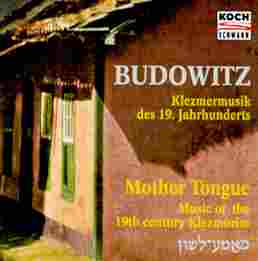
total time: 58:46
released: 1997
label: Koch/Schwann (3-1261-2 H1)
No address listed
|
Joshua Horowitz: tsimbl, 19th century button accordion
Walt Mahovlich: C clarinet
Steven Greenman: violin
Lothar Lasser: 19th century button accordion
Geza Penzes: cello, contrabass
Special guest: Cili Schwartz: voice (track 1 only)
Program:
- Cili's Kale Bazingns
- Bughici's Tish Nign
- Gut Morgn
- Unzer Toyrele
- Bolgarskii Zhok
- Pedotser's Tants
- Fried's Sher
- Yankowitz's Doina
- Druker's Bulgarish
- Beckman's Hora
- Rumeynishe Sirba
- Gute Nakht Sirba
- Solinski's Rumeynishe Fantazi
- Bessaraber Khusidl
- Belf's Khusidl
- Leibowitz's Khusidl
- Mazeltov, Mazeltov
- Horowitz's Doina
- Freylekhs Fun der Khupe
- Steiner's Honga
- Schwartz's Sirba
- Dulitski's Skocne
- Ukraynishe Kolomeyke
(all melodies are traditional, except 18, composed by Horowitz)
|
Review by Henry Doktorski:
Mother Tongue is one of the most enjoyable and historically
authentic albums of nineteenth-century klezmer music on original
instruments I have ever had the pleasure to listen to. The group
Budowitz is
considered the "early music" ensemble of klezmer music, and for good
reason: they have amassed considerable research on the stylistic
characteristics and performance practices of archaic klezmer music; so
much so that Baroque and Renaissance early music specialists often ask the
members of Budowitz about performance practice techniques, since
the folk and classical styles had many parallels.
Although the members of Budowitz are scholars, their music is full
of life, despite their classical training! There is a fascinating
interview in the CD booklet notes (which is a full 30 pages long!) which I
quote from:
Interviewer: You talk about your music like musicologists?
Budowitz: Only because you ask about it like one. Actually, all of
us have survived classical training and are miraculously still able to
play. The saving factor being that we've all gotten dirty enough playing
lots of different styles in every imaginable situation. We're all street
players as well as concert players, and we've done the wedding
shtick over and over.
Of special interest to readers of The Free-Reed Review are the two
accordions on the album, played by Joshua Horowitz and Lothar Lasser. Both
instruments are three-row chromatic button accordions with about a
three-octave range in the right hand and perhaps a half-dozen bass & chord
buttons in the left hand. I quote from the interview:
Interviewer: What gives your accordions their specific sound?
Budowitz: It's amazing how much more you can ornament on these old
ones. Our instruments were made in 1889 and at the turn of the century,
which is ancient for an accordion, and the unrelenting work to restore
them and get them working has really paid off. Their warmth comes mainly
from the fact that the reeds are riveted to brass plates, rather than to
aluminum or zinc, which eventually replaced brass. The reeds are also from
a richer alloy than you find in modern reeds, and the goat leather used on
the plates also adds warmth. We often get comments that they don't even
sound like accordions, because they're so delicate and rich, and because
they sometimes seem to 'speak.' The idea of the free-swinging reed and
bellows-propelled air mass is actually very old, so the archaic sound we
get fits really well into the concept of our sound. Our instruments are
small and soft, yet it takes much more physical energy to play them than
it does a modern accordion. Their inefficiency makes possible more nuance,
because the lightly touched embellishment notes come out more faintly than
on a modern accordion, where they're too crudely audible.
The earliest model we have for our accordion style is Max Yankowitz, whose
1913 recordings gave us our foundation. There were other accordionists,
too, and we've learned and gone beyond those examples.
We base our sound and technique on the voice; our whole approach to
fingering and bellows technique is geared toward producing the nuances of
Yiddish singing. Like the early clavecin players before Bach, we basically
use three fingers, though we include the thumb. The 4th finger is usually
reserved as a krekhts finger, often touching the note above the
main melody note to get that weeping thing, and the 5th finger is mostly
used in 'emergencies.'
Joshua Horowitz told me the story about his acquisition of this
19th-century instrument:
My accordion was built in 1889 by Karl Budowitz, who was born in the
Czech Repuplic and moved with his brother Joseph (who also made
accordions- actually *harmonikas*- which is what they called instruments
whose buttons or keys didn't play chords automatically when pushed) to
Vienna in the middle of the 19th Century. They perfected the first fully
chromatic button accordion system—apparently developed by Franz Walter—and came to be known as the Stradivarius of the harmonika, because their
instruments were so well crafted.
His instruments found their way into the Schrammel brothers' ensemble, and
so came to be known as the Schrammelharmonika, though the instruments
themselves were widely distributed, and became the basis for the Russian
Bayan system.
I played at a folk festival in Southern Austria several years ago and
heard a modernized Schrammel group playing. I thought I was hearing the
early Yankowitz accordion (1913 Klezmer on 78's) as the sound was
identical. Henceforth I was obsessed with getting such an instrument. It
took 6 months of search until I found a woman whose husband had died, and
who had owned a *Budowitzer.* After much finagling and slimy dealing (she
raised the price every time I called her) I borrowed a friend's car, went
to Perchtoldsdorf in lower Austria and bought it from her, spent 6 more
months renovating it, and finally learning the rather impenetrable system.
The difference in sound and feel from a modern accordion is so great, that
I wouldn't trade it for anything, in spite of the fact that it is a very
temperamental instrument. I call it my sweet old lady for many reasons.
So there you have it.
My opinion of the CD? Although for the most part in all honesty I am NOT a
folk music fan—preferring to listen instead to classical music—
(despite the fact that I regularly play klezmer accordion with The
Steel City Klezmorium! and sometimes I even play with Budowitz's
violinist Steven Greenman when he is back in the U.S. taking a break
from his European tours with Budowitz—see reviews of
Klezmer Music—A Marriage of
Heaven and Earth and Richard
Galliano: Laurita)
this album caught my fancy more than nearly all of the other folk music
CDs in my collection. Budowitz's performances are dignified,
artistic and expressive. I cannot recommend them highly enough. I think
this CD is a MUST for folk music enthusiasts.