The Free-Reed Review
Critiques of Compact Discs, Books and Music Scores
CD Review: Antonio Barberena
Acordeôn de Concierto
 Total Time: 72:46
Released: 2000
Review Date: April 2001
Order from:
Antonio Barberena
Hidalgo 21, Cabecera Mpal.
Coacalco, Estado de Mexico
55799 MEXICO
Email:
|
Antonio Barberena, Acordeôn clasico
Program:
- J. S. Bach: Preludio y fuga en Fa mayor, BWV 556
- Gaspar Sanz: Suite española
- Don Hernando Franco: Motetes a Santa Maria
- Joseph de Torres: Batalla
- Anonimo: Sonatas del archivo de la Catedral de México
- Léon Boellmann: Suite Gotica
- Adamo Volpi: Preludio, op. 31
- Vladislav Solotarev: Sonata No. 2
- Carlos Gardel: El dia que me quieras - Tango
|
Review by Henry Doktorski:
Although I have listened to more than two hundred classical accordion CDs
by dozens and dozens of players from around the world, I had not heard of
any Mexican classical accordionists, until Antonio Barberena sent me his
CD. What a pleasant surprise!
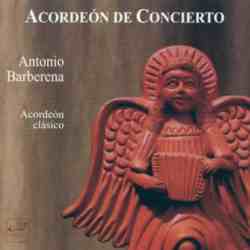
First of all, the artwork and packaging is superb; the CD jewel case is
even encased by a printed cardboard sleeve. The sculpture of an
accordion-playing angel is charming, and reflects the folk art of Catholic
Mexico, as well as the Baroque contents of this CD (which includes three
pieces recently discovered in the library of the Mexico City Cathedral).
But the greater surprise to me was Barberena's playing: clear, articulate
and musical (and the recording is also professionally engineered).
Barberena's playing is not spectacular, but it is solid; rather reserved.
I had no idea such a high caliber of classical accordion art existed in
Mexico. Barberena (born in 1962) began playing piano accordion at the age
of eleven and switched to the chromatic button accordion at fifteen.
(Sounds a lot like the United States' own Peter Soave.) He won first place
at the 5th National Accordion Championship in Mexico City. He recorded two
LPs, founded the Accordion Quintet of Mexico City and concertized in
Spain, Venezuela, Switzerland, Argentina, Chile, and the USA (Houston,
Texas).
The works on the program (mostly transcriptions) are well-played and
well-balanced, despite a preponderance (more than half) of Baroque
pieces. Bach's Prelude and Fugue in F Major and Boellmann's
Suite Gothic were originally written for organ, and Sanz's Suite
Espanola, for guitar. The three Mexican pieces date from as early as
1599 and were written for either organ or harpsichord. The only pieces
specifically written for accordion are Adamo Volpi's Preludio,
also in the Baroque style and Vladimir Zolotarev's Sonata No. 2,
which is certainly—along with Boellmann's Gothic Suite— the
most substantial piece on the program.
I can only find fault with two aspects of the CD, one minor and one major.
1. The CD booklet notes (written in Spanish and English) are OK as far as
content goes. The English translations should have been checked by someone
more conversant in English; the sentence structures are awkward, but this
is tolerable. While reading about the history of the accordion, I was
delighted that a good portion of the notes were taken from my book,
The Classical Squeezebox, and that my name was acknowledged. I only
wish they would have spelled my name correctly! (Is DOKTORSKI
so hard to spell?)
2. The other and far more significant criticism is the equalization of the
left hand: the bass frequencies are boosted up to such an extent that the
instrument hardly sounds like an accordion anymore. Any accordionist knows
that the left hand sound is notoriously lacking in depth due to the
inability of accordion manufacturers to squeeze correctly proportioned
reeds into the bass mechanism. We know from elementary physics that the
larger the object, the slower its vibration. The top notes of a concert
grand piano, for instance, are produced from strings only a few inches in
length, while the bottom notes are produced from strings nine or ten feet
long. The upright and console pianos lack in the low frequencies because
to save space manufacturers have to cram in strings which cannot exceed a
few feet in length. What one gains in space one loses in sonic depth.
The accordion is like an organ. The top notes of a pipe organ are produced
from pipes only an inch or two in length, while the pedal notes are
produced from pipes between sixteen and 32 feet in length. (Really grand
organs have bass pipes which measure in at 64 feet!) For an accordion to
have an authentically deep bass, it would need to have reeds more than a
foot long. This is impractical, although it is possible to put large bass
reeds in a harmonium. This is why the harmonium has the deepest bass notes
of all the free-reed instruments.
The accordion manufacturers get around this law of physics by soldering
heavy weights on the ends of the bass reeds to slow down their rate of
vibration. This lowers the pitch, but weakens the fundamental frequency.
For decades accordionists have tried to compensate for this by amplifying
their instruments with contact microphones inside the instrument; one set
for right hand and one set for left hand, both with separate tone
controls. In this way they can artificially increase the depth of their
bass notes. I have heard that Charles Magnante never played without an
amplifier. I suspect he was embarrassed by his instrument's unaltered bass
sound.
Using an amplifier and altering the sound of the instrument may be
acceptable for jazz accordionists, but classical accordionists should
beware of changing the timbre of their instrument on a recording solely
for the sake of what they think will be a more pleasing sound. Barberena's
instrument sounds bottom heavy on this recording. I don't deny that it is
a pleasing effect, but it is not authentic. If a listener first hears
Barberena's recording, and then hears him live in concert, the listener
may be disappointed by the tiny sounds coming from the left hand in real
life. I think it is best to be honest and present the accordion for what
it is, despite its limitations. This was also discussed in a review of
Friedrich Lips De Profundis and Et Exspecto
CDs by Paul Magistretti.
At the risk of offending some readers, I will propose an analogy. The
practice of artificial enhancement can be applied to other arts as well,
such as the art of female breast enlargement. What is more important, size
or authenticity? Is bigger really better? Barberena's bass sounds like
a triple D; attractive certainly (and perhaps even sexy), but extremely
exaggerated.
I believe, regarding the art of the classical accordion at least, that it
is better to present one's instrument to the public free from electronic
effects such as boosted bass equalization, as long as the composer does
not specifically call for such sonic enlargements in the score.
Despite this criticism of Barberena's artificially enhanced bass, I
believe most listeners will enjoy this rare treat of music from Mexico. It
is really a pleasant surprise.
Readers' Comments:
The comparison between the enhanced bass and mammaries was humorous—I
laughed out loud when I read it! :-)
Thomas Fabinski
Warren, Michigan