The Free-Reed Review
Critiques of Compact Discs, Books and Music Scores
CD Review: Allan W. Atlas
The Wheatstone English Concertina in Victorian England
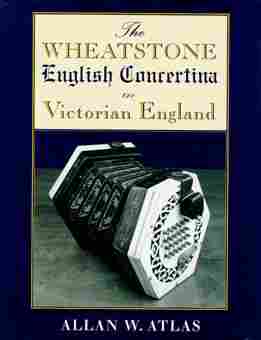
publisher: Oxford University Press (0-19-816580-3)
Saxon Way West
Corby Northamptonshire
NN18 9ES United Kingdom
phone: +44 (0)1536 741519
fax: +44 (0)1536 454518
|
Contents:
- List of Plates
- List of Musical Examples
- An Instrument for All Classes
- Wheatstone's English Concertina: The Standard Instrument at Mid-Century
- Charles Wheatstone Invents the Concertina
- Two Performance-Related Problems
- The Concertina on the Concert-Platform: Players - Repertoire - Reception
- Notes on the Music in the Edition
Music Editions:
- Joseph Warren, Grand Fantasia on 'Deh! con te'
- Richard Manning Blagrove, Morceaux
- George Alexander Macfarren, Romance
- Giulio Regondi, Serenade
- John Charles Ward, Menuet and Trio, Op. 19
- Select Discography
- Bibliography
- Index of Names
155 pages, 11 plates, 3 figures, 2 tables, 16 music examples, 5 pieces of music for the instrument, hardcover, published in 1996
Review number and date: No. 66: September 1997
|
Review by
Henry Doktorski:
The Wheatstone English Concertina in Victorian England is a
treasure for free-reed devotees, classical music lovers and musicologists.
Once I picked the book up, I could not put it down.
The author, Allan Atlas, is Professor of Music at Brooklyn College &
Graduate School at The City University of New York—and a classical
concertinist as well. His book is scholarly, yet remarkably easy to read
and full of fascinating facts. Did you know that early nineteenth-century
concertinas were tuned to the mean-tone system and had fourteen notes to
the octave?
Or that the best concertinas had gold-plated reeds? (One instrument in the
1862 catalog by the concertina-maker Louis Lachenal had 48 keys with ivory
tops, silver or glass buttons and gold plated reeds.)
Or did you know that the famous English author, Charles Dickens, was an
avid accordionist?
In my opinion, Atlas' book is especially important due to the inclusion of
five music scores by the mid-nineteenth century composers Joseph Warren,
Richard Manning, George Alexander Macfarren, Giulio Regondi and John
Charles Ward, some of which are reproductions of the original published
music scores. Thus this treatise is not simply for scholars but also for
performers.
In conclusion, let me quote a paragraph by William Cawdell from his
Short Account of the English Concertina in which he praises the
merits of the instrument.
"There exist many reasons why a fair and earnest inquiry into the
merits of the concertina at the present time should be acceptable . . .
[it has a] sweet tone . . . passages of sustained notes as well as harmony
. . . power of expression . . . portable . . . adapted to every style . .
. varied compass . . . tuned to equal or unequal temperament and to any
pitch that may be desireable . . . the very easiest of instruments for the
learner . . . the concertina may be played in any position, standing,
sitting, walking, kneeling, or even lying down. If confined to the house
by a sprained ankle, you may play whilst reclining on a sofa . . . and
when you are convalescent, you may take your instrument into the fields
where the piano can never be."
In my opinion,The Wheatstone English Concertina in Victorian
England, by Allan Atlas is a must for all free-reed lovers.